Building an 8-bit computer from logic gates, by hand
Senior Capstone Project · Engineering Pathway Capstone · High School Engineering Pathway · 2022 — 2023
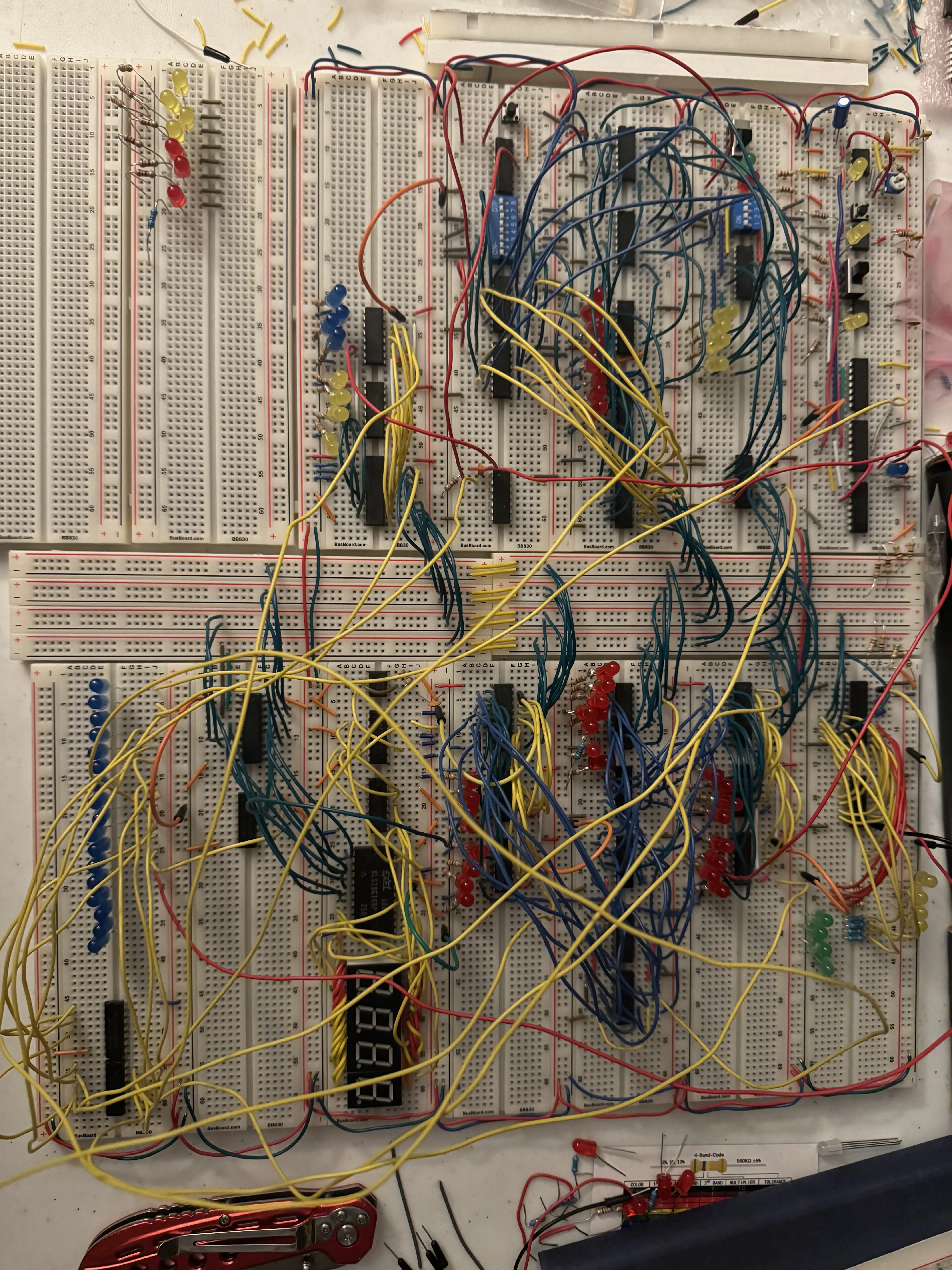
It started with a game. Playing Turing Complete, I built a working computer from a single NAND gate up. Once I'd made an 8-bit machine in the game, I decided to build a real one, a physical 8-bit computer wired from simple logic gates on breadboards, inspired by Ben Eater's series.
The problem
I wanted to actually understand how a computer works, not at the level of 'the CPU runs instructions,' but down to the gates. A simulator gets you part of the way; I wanted to bridge from the game to real, debuggable hardware on a bench.
That meant turning a stack of logic-gate ICs, EEPROMs, LEDs, and wire into a coherent machine: an ALU, registers, a program counter, RAM, a clock, control logic, and a display. They all talking to each other correctly.
What I built
- 1
Learn the fundamentals
I worked through Ben Eater's guide and studied schematics and digital logic. Including how AND, OR, NOT, NAND, NOR, and XOR gates behave, and how microprocessor architecture executes instructions and moves data between components.
- 2
Source the components
I bought and organized the parts: logic-gate ICs, breadboards, EEPROMs, LEDs, and a lot of wire, so I had the needed materials for each subsystem.
- 3
Wire, debug, repeat
I built it incrementally, wiring a component, debugging it, and repeating, then connected each individual component into one working machine. Debugging hundreds of jumper wires by hand was the real teacher.